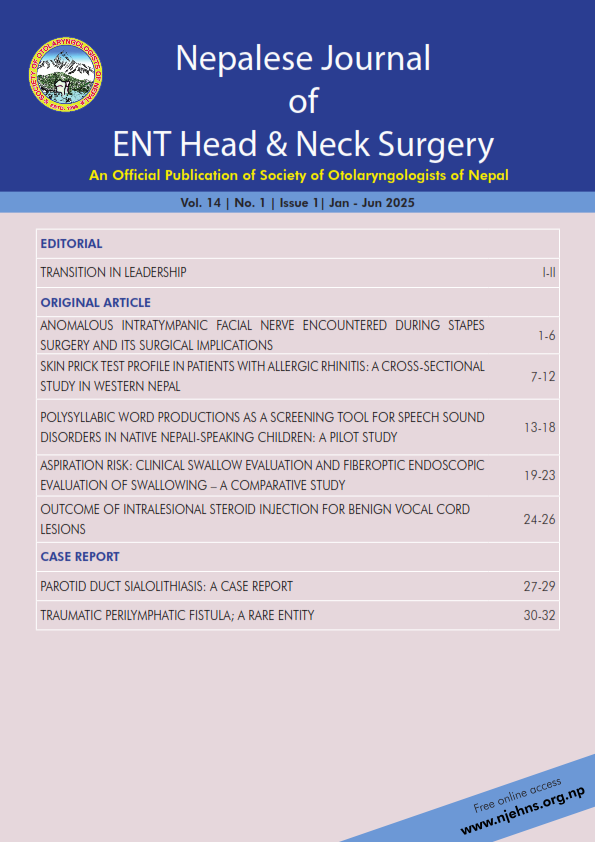
Polysyllabic Word Productions as a Screening Tool for Speech Sound Disorders in Native Nepali-Speaking Children: A Pilot Study
Abstract
Aims and Objectives: Speech sound disorders (SSD) affect children’s communication, learning, and social participation, yet culturally adapted screeners are scarce in Nepal. Polysyllabic words (≥3 syllables) place higher demands on speech planning and phonotactics, making them useful for detecting SSD. This study aimed to develop and pilot a brief Nepali polysyllable screener for three to five years, preschool children.
Methods: A cross-sectional, known-groups validation design was employed. Twenty native Nepali-speaking children out of whom 10 were SSD and 10 were typically developing (TD) were matched for age and sex. They were assessed using a 10-item picturable polysyllable word list. Responses were audio-recorded, scored dichotomously, and analyzed for group differences, internal consistency, and diagnostic accuracy.
Results: TD children obtained significantly higher scores (mean score=9.1) than SSD peers (mean scoe = 5.2), with a large effect size (Cohen’s d = 3.5). Item-level analyses showed adequate discrimination (corrected item–total correlations 0.41–0.74). Internal consistency was good (KR-20 = 0.82). Receiver operating characteristic (ROC) analysis demonstrated excellent diagnostic accuracy (AUC = 0.94, 95% CI 0.83–1.00). An optimal cutoff of ≤7 yielded sensitivity of 0.90 and specificity of 0.95.
Conclusion: The Nepali 10-item polysyllable screener reliably distinguished SSD from TD speech in preschool children. Although limited by small sample size, findings highlight its potential as a clinically valid, rapid triage tool for early identification of SSD in Nepalese schools and clinics.
Downloads
Published
How to Cite
Issue
Section
License
Copyright (c) 2026 Nepalese Journal of ENT Head & Neck Surgery

This work is licensed under a Creative Commons Attribution-NonCommercial 4.0 International License.